Archives

“Adaptive Ministry”

“Adaptive Ministry” – Cameron Young, guest speaker (pronouns they/them)

Download the Morning Program here or read it below without downloading

Of their discourse, Cameron writes:

This year has been unprecedented for Unitarian Universalist Congregations, as many have sought ministers only to come up empty-handed. This shortage in ministers is not unique to UU or even religious organizations, but universal to all helping professions in the country. Why the shift? What does our shared theology say about how we, as beacons of liberal faith, must adapt to an era where change is constant?

Introducing our guest speaker:

Cameron Young is a native Texan and lifelong Unitarian Universalist. Having grown up in those programs, they developed a particular affinity for youth and young adult ministry. Prior to joining the UUA, Cameron served as a lifespan religious educator in Fort Worth, Texas for five years, having helped to implement their congregation’s first ever Coming of Age, Spirit Play, and Young Adults programs. Cameron also served a two-year elected position as Young Adult Co-Facilitator at General Assembly. Cameron has a Bachelor of Music from Louisiana State University and is currently a seminarian at Fort Worth’s Brite Divinity School. A professional musician and classically trained singer, Cameron has performed in numerous operas, musicals, is a member and co-founder of DFW’s Uptown Carolers, a professional Christmas caroling company, and also recorded with Grammy award winner Leon Bridges on his debut album. In their spare time, Cameron is an avid traveler, diehard fan of Dallas sports teams, and devoted coffee drinker.

Two Trillion and Counting

Two Trillion and Counting

The Rev. Dr. Mark Y.A. Davies, leading

DOWNLOAD THE MORNING PROGRAM HERE or read it below without downloading

What impact does the knowledge that there are likely more than 2 trillion galaxies in the universe have on our self-understanding and on our religious vision of ourselves within the cosmos?

About our visiting minister:

Rev. Dr. Mark Y. A. Davies is the Wimberly Professor of Social and Ecological Ethics, Director of the World House Institute for Social and Ecological Responsibility, and Executive Director of the Leadership. Education, and Development (LEaD) Hub North United States for the General Board of Higher Education and Ministry (GBHEM) at Oklahoma City University where he has worked in both teaching and administration for 25 years. He is an ordained elder in the Oklahoma Conference of the United Methodist Church where he has served as Chair of the Board of Church and Society from 2015 to 2018.

Mark’s Ph.D. is from Boston University in the area of Social Ethics, and he has served Boston University School of Theology (BUSTH) as a member of its Dean’s Advisory Board and as the alumnus representative on BUSTH’s Green Team as part of the Green Seminary Initiative.

Mark has led and implemented a number of initiatives in coordination with the Division of Higher Education of the United Methodist Church including a Methodist Higher Education Global Ethics Initiative from 2008 to 2012, a United Methodist Higher Education Interfaith Initiative from 2015 to present, and a Global Methodist Higher Education Social and Ecological Responsibility Initiative from December 2016 to the present. Mark has published in the areas of Boston personalism, process philosophy and ethics, and ecological ethics.

In 2017, the General Board of Church and Society of the United Methodist Church selected Dr. Davies to serve as the convener of the writing team tasked with revising “The Natural World” section of the Social Principles of the United Methodist Church. This is the first time the Social Principles have undergone a thorough revision since their adoption by the denomination in 1972.

Mark is one of the inaugural members of the New Room Books Editorial Board. New Room Books is a reviewed academic monograph series that offers scholars from the Methodist tradition and their students a way to share their work.

Since 2015, Mark has served on the United Methodist University Senate, which is “an elected body of professionals in higher education created by the General Conference to determine which schools, colleges, universities, and theological schools meet the criteria for listing as institutions affiliated with The United Methodist Church.”

Mark engages in advocacy and activism in the areas of peace, social justice, and ecological sustainability. Locally this is expressed through his work with the Human Community Network, which works to create non-violent systemic change for a just and flourishing human and ecological community through collaboration, education, innovation, and action. See www.humancommunitynetwork.org.

He and his wife Kristin live in Edmond, OK in the United States, and they have two daughters who attend Oklahoma City University.

“Justice Interconnected” –

Download The Morning Program here (or read it below w/o downloading)

Justice Interconnected – the Rev. Dr. Mark Y. A. Davies, leading

Of his discourse, Mark writes:

Martin Luther King wisely noted that “Injustice anywhere is a threat to justice everywhere.” Social Justice concerns within our society are intimately connected with one another, and it is critical for advocates and activists for a just society to recognize these connections for a holistic approach to social change. 

About our visiting minister:
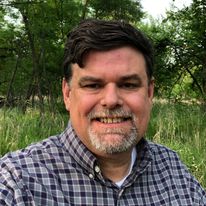
Rev. Dr. Mark Y. A. Davies is the Wimberly Professor of Social and Ecological Ethics, Director of the World House Institute for Social and Ecological Responsibility, and Executive Director of the Leadership. Education, and Development (LEaD) Hub North United States for the General Board of Higher Education and Ministry (GBHEM) at Oklahoma City University where he has worked in both teaching and administration for 25 years. He is an ordained elder in the Oklahoma Conference of the United Methodist Church where he has served as Chair of the Board of Church and Society from 2015 to 2018.

Mark’s Ph.D. is from Boston University in the area of Social Ethics, and he has served Boston University School of Theology (BUSTH) as a member of its Dean’s Advisory Board and as the alumnus representative on BUSTH’s Green Team as part of the Green Seminary Initiative.

Mark has led and implemented a number of initiatives in coordination with the Division of Higher Education of the United Methodist Church including a Methodist Higher Education Global Ethics Initiative from 2008 to 2012, a United Methodist Higher Education Interfaith Initiative from 2015 to present, and a Global Methodist Higher Education Social and Ecological Responsibility Initiative from December 2016 to the present. Mark has published in the areas of Boston personalism, process philosophy and ethics, and ecological ethics.

In 2017, the General Board of Church and Society of the United Methodist Church selected Dr. Davies to serve as the convener of the writing team tasked with revising “The Natural World” section of the Social Principles of the United Methodist Church. This is the first time the Social Principles have undergone a thorough revision since their adoption by the denomination in 1972.

Mark is one of the inaugural members of the New Room Books Editorial Board. New Room Books is a reviewed academic monograph series that offers scholars from the Methodist tradition and their students a way to share their work.

Since 2015, Mark has served on the United Methodist University Senate, which is “an elected body of professionals in higher education created by the General Conference to determine which schools, colleges, universities, and theological schools meet the criteria for listing as institutions affiliated with The United Methodist Church.”

Mark engages in advocacy and activism in the areas of peace, social justice, and ecological sustainability. Locally this is expressed through his work with the Human Community Network, which works to create non-violent systemic change for a just and flourishing human and ecological community through collaboration, education, innovation, and action. See www.humancommunitynetwork.org.

He and his wife Kristin live in Edmond, OK in the United States, and they have two daughters who attend Oklahoma City University.

 

“Fighting the Merchants of Death”

Download the Morning Program here or read it online below without having to download it.

Of his upcoming discourse, Dr. Davies writes:

When there is money to be made, human health and safety often come second and the environment usually comes third to profits. In many cases government agencies and corporations work closely together to keep it that way. What can be done to break this collusion between government and corporations that continues to put profits over people and the planet?

About our visiting minister:

Rev. Dr. Mark Y. A. Davies is the Wimberly Professor of Social and Ecological Ethics, Director of the World House Institute for Social and Ecological Responsibility, and Executive Director of the Leadership. Education, and Development (LEaD) Hub North United States for the General Board of Higher Education and Ministry (GBHEM) at Oklahoma City University where he has worked in both teaching and administration for 25 years. He is an ordained elder in the Oklahoma Conference of the United Methodist Church where he has served as Chair of the Board of Church and Society from 2015 to 2018.

Mark’s Ph.D. is from Boston University in the area of Social Ethics, and he has served Boston University School of Theology (BUSTH) as a member of its Dean’s Advisory Board and as the alumnus representative on BUSTH’s Green Team as part of the Green Seminary Initiative.

Mark has led and implemented a number of initiatives in coordination with the Division of Higher Education of the United Methodist Church including a Methodist Higher Education Global Ethics Initiative from 2008 to 2012, a United Methodist Higher Education Interfaith Initiative from 2015 to present, and a Global Methodist Higher Education Social and Ecological Responsibility Initiative from December 2016 to the present. Mark has published in the areas of Boston personalism, process philosophy and ethics, and ecological ethics.

In 2017, the General Board of Church and Society of the United Methodist Church selected Dr. Davies to serve as the convener of the writing team tasked with revising “The Natural World” section of the Social Principles of the United Methodist Church. This is the first time the Social Principles have undergone a thorough revision since their adoption by the denomination in 1972.

Mark is one of the inaugural members of the New Room Books Editorial Board. New Room Books is a reviewed academic monograph series that offers scholars from the Methodist tradition and their students a way to share their work.

Since 2015, Mark has served on the United Methodist University Senate, which is “an elected body of professionals in higher education created by the General Conference to determine which schools, colleges, universities, and theological schools meet the criteria for listing as institutions affiliated with The United Methodist Church.”

Mark engages in advocacy and activism in the areas of peace, social justice, and ecological sustainability. Locally this is expressed through his work with the Human Community Network, which works to create non-violent systemic change for a just and flourishing human and ecological community through collaboration, education, innovation, and action. See www.humancommunitynetwork.org.

He and his wife Kristin live in Edmond, OK in the United States, and they have two daughters who attend Oklahoma City University.
“Love Calls Us On”

Download the Morning Program here or scroll below and read the morning program without having to download it.

Of his remarks, Dr. Sinkford writes:

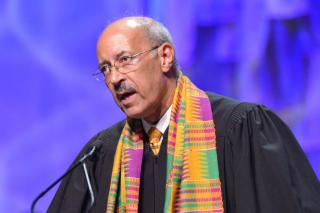
Love Calls Us On: Our national narrative and our faith’s story present us as both innocent and wise. The facts on the ground tell a more complicated story. What does faithfulness require when the wisdom of the past seems to be failing? What is love calling us to do in these divisive times when innocence is no longer an option?

About our guest minister

Mr. Sinkford, spent his childhood in Cincinnati and became a Unitarian-Universalist when he was 14 years old. He wrote, I claimed the church when as a young black man, I walked into First Unitarian, Cincinnati, and found a religious community where I could be fully myself. Though he left in the 1970s believing that the Universalists had retreated from engagement with racial justice. He returned to find a religious home for his two children. He was ordained in 1995.

In 2001 he became the seventh president of the Unitarian Universalist Association of Congregations.[3] In 2003, Sinkford said the “main goal of his presidency of the Unitarian Universalist Association was to reclaim a “vocabulary of reverence” within the association; he had been struck by the fact that the association’s Purposes and Principles “contain not one piece of traditional religious language, not one word”; it includes generalizations about human dignity, justice and “the interdependent web of all existence,” but does not do much “to capture our individual searches for truth and meaning.” Sinkford has previously considered himself a “card-carrying atheist” who in 1997, after his comatose son had recovered, began to develop a “prayer life centered on thankfulness and gratefulness to God.” William F. Schulz who had served as UUA president from 1985 to 1993, supported Sinkford’s efforts to use a “wide lexicon” of religious language, and had “long been critical of the position of some humanists that would sanctify secular language and lock us into a calcified rationalism.”

Since 2010, he has served as the senior minister for the First Unitarian Church in Portland, Oregon.

“Fighting Theocracy”

You may download the morning program here or read it online below without downloading.

With reproductive justice under attack, “don’t say gay” laws gaining traction, and a warped view of religious freedom threatening civil rights; the real possibility of theocracy is at our doorstep, and the Supreme Court of the United States can no longer be counted on to stop it. What can be done to stop the increasing influence of theocratic visions and practices within our society? 


About our returning guest minister:

Rev. Dr. Mark Y. A. Davies is the Wimberly Professor of Social and Ecological Ethics, Director of the World House Institute for Social and Ecological Responsibility, and Executive Director of the Leadership. Education, and Development (LEaD) Hub North United States for the General Board of Higher Education and Ministry (GBHEM) at Oklahoma City University where he has worked in both teaching and administration for 25 years. He is an ordained elder in the Oklahoma Conference of the United Methodist Church where he has served as Chair of the Board of Church and Society from 2015 to 2018.

Mark’s Ph.D. is from Boston University in the area of Social Ethics, and he has served Boston University School of Theology (BUSTH) as a member of its Dean’s Advisory Board and as the alumnus representative on BUSTH’s Green Team as part of the Green Seminary Initiative.

Mark has led and implemented a number of initiatives in coordination with the Division of Higher Education of the United Methodist Church including a Methodist Higher Education Global Ethics Initiative from 2008 to 2012, a United Methodist Higher Education Interfaith Initiative from 2015 to present, and a Global Methodist Higher Education Social and Ecological Responsibility Initiative from December 2016 to the present. Mark has published in the areas of Boston personalism, process philosophy and ethics, and ecological ethics.

In 2017, the General Board of Church and Society of the United Methodist Church selected Dr. Davies to serve as the convener of the writing team tasked with revising “The Natural World” section of the Social Principles of the United Methodist Church. This is the first time the Social Principles have undergone a thorough revision since their adoption by the denomination in 1972.

Mark is one of the inaugural members of the New Room Books Editorial Board. New Room Books is a reviewed academic monograph series that offers scholars from the Methodist tradition and their students a way to share their work.

Since 2015, Mark has served on the United Methodist University Senate, which is “an elected body of professionals in higher education created by the General Conference to determine which schools, colleges, universities, and theological schools meet the criteria for listing as institutions affiliated with The United Methodist Church.”

Mark engages in advocacy and activism in the areas of peace, social justice, and ecological sustainability. Locally this is expressed through his work with the Human Community Network, which works to create non-violent systemic change for a just and flourishing human and ecological community through collaboration, education, innovation, and action. See www.humancommunitynetwork.org.

He and his wife Kristin live in Edmond, OK in the United States, and they have two daughters who attend Oklahoma City University.
THE MORNING PROGRAM [tap/click the bottom of the page to see the next page]

“Love, The Final Frontier”

You may download the morning program here or you can read it w/o downloading below

In 1966 Gene Roddenbery introduced the world to Star Trek, a series that continues to light up our imaginations almost 60 years later. I avoided watching the show for one reason: the word Frontier. Do we really need another TV show praising the evils of colonization, only in space?  I recently gave the show a chance and realized that my assessment might have been wrong. So, I ask two questions: What if frontier was redefined?  And how can the UU faith lead the way in navigating this frontier?

Introducing our guest speaker…

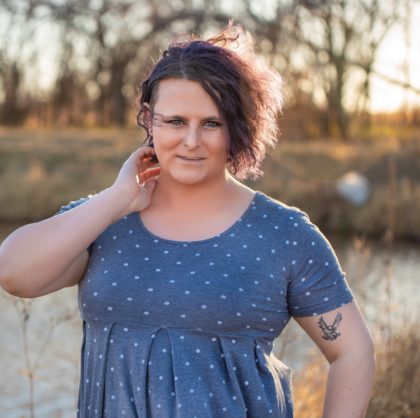
Ashley Newlin (she/her) is entering her fourth and final year as a Masters of Divinity student at Brite Divinity School. Where she just completed her 1 year term as Moderator of the Brite Student Association (BSA). During this term BSA implemented a mentoring program, which helped connect new students connect with students further along in their studies to help them transition into the seminary environment. As well as her continued work on structurally reforming the student government to be more representative of all student groups on campus, which is due to be completed by August of this year. She also continues to serve as a Resident Assistant at Leibrock Village, which provides affordable housing for graduate students at Brite and TCU. Before beginning her seminary career at Brite she served as a Youth Pastor in a couple of Nazarene Churches in Oklahoma, as well as serving as a Child Welfare Specialist for Oklahoma Department of Human Services. Some of her hobbies include playing guitar and playing rugby. 
“Transgender in Comon Usage and Jurisprudence”

“Transgender in Comon Usage and Jurisprudence” Dr. Rachel Tudor, guest speaker

Download the Morning Program or read it below

Of her discourse, Dr. Tudor writes:

Names and labels are used to identify and, all too often, exclude, marginalize, and literally demonize people who are different or see the world differently. Through the use of the power of naming, individuals and communities are deprived of their rights and dignity as human beings. The neologism “transgender” is one such name/label. I will share my experiences with this label in reference to employment justice and our culture.

Introducing Dr. Tudor:

The 10th Circuit ordered Dr. Tudor’s reinstatement as a tenured professor at Southeastern in the Fall of 2021 after a decade of litigation. She is the first tenured Native American professor in her department in its 125+ year history. Her undergraduate degree was developed by a collaboration between the National Aeronautics and Space Administration (NASA) and the University of Houston emphasizing analytical future studies and environmental earth science. The curriculum provided a robust foundation in natural science to juxtapose with her Master’s degree in Humanities with an emphasis in philosophy. She earned her PhD at the University of Oklahoma concentrating on literature.
 

“Going Local”

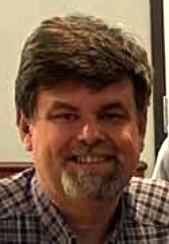
Download the Morning Program HERE or just read it below.

Marks comments about his upcoming discourse:

Going Local

OF HIS UPCOMING DISCOURSE MARK WRITES:  2000-mile salads, money streaming out of our local communities, dependence on global corporations, living in debt, little to no connection and commerce with the people around us, over-dependence on fossil fuel, depopulation and impoverishment of rural communities – these are the hallmarks of a global economy with little concern for the flourishing of our local communities. But there is a movement that is working to transform our systems in a more local direction.

INTRODUCING OUR GUEST MINISTER: Leading today’s morning assembly is the Rev. Dr. Mark Y.A. Davies.  Mark is the Wimberly Professor of Social and Ecological Ethics at Oklahoma City University where he has worked in both teaching and administration for 25 years. He is an ordained elder in the Oklahoma Conference of the United Methodist Church.

Mark’s Ph.D. is from Boston University in the area of Social Ethics, and he has served Boston University School of Theology as a member of its Dean’s Advisory Board and as the alumnus representative their Green Team as part of the Green Seminary Initiative.

Mark engages in advocacy and activism in the areas of peace, social justice, and ecological sustainability. Locally this is expressed through his work with the Human Community Network, which works to create non-violent systemic change for a just and flourishing human and ecological community through collaboration, education, innovation, and action. See www.humancommunitynetwork.org.

He and his wife Kristin live in Edmond, OK in the United States, and they have two daughters who attend Oklahoma City University.

THE MORNING PROGRAM:

Pernicious Propaganda

Download The Morning Program here or read it embedded below.

Marks comments about his upcoming discourse:  Everywhere we turn we are immersed in propaganda that is being used to persuade us to believe and act in ways others wish us to believe and act, often with little regard for the truth or the common good. Are there ways for us to weaken the pernicious power that propaganda has in our lives?

INTRODUCING OUR GUEST MINISTER: Leading today’s morning assembly is the Rev. Dr. Mark Y.A. Davies.  Mark is the Wimberly Professor of Social and Ecological Ethics at Oklahoma City University where he has worked in both teaching and administration for 25 years. He is an ordained elder in the Oklahoma Conference of the United Methodist Church.

Mark’s Ph.D. is from Boston University in the area of Social Ethics, and he has served Boston University School of Theology as a member of its Dean’s Advisory Board and as the alumnus representative their Green Team as part of the Green Seminary Initiative.

Mark engages in advocacy and activism in the areas of peace, social justice, and ecological sustainability. Locally this is expressed through his work with the Human Community Network, which works to create non-violent systemic change for a just and flourishing human and ecological community through collaboration, education, innovation, and action. See www.humancommunitynetwork.org.

He and his wife Kristin live in Edmond, OK in the United States, and they have two daughters who attend Oklahoma City University.