Valentine’s Day, 1992. It was my junior year at Georgetown University, I was twenty years old, and I was standing in the middle of Key Bridge, which straddles the Potomac River between Washington, DC, and Virginia, on a day dedicated to romantic love. My life was a mess, and I figured that I might as well end it. I had grown up in a traditional Hindu immigrant family, with unambiguous expectations of heterosexual marriage. And I was gay. I had pretended I wasn’t gay. I had tried not to be gay. I had prayed not to be gay. None of that had worked, and so here I was: damned if I came out of the closet, with the possible loss of family, friends, and life as I knew it, and damned if I didn’t, with the inevitably of a straight marriage that I knew I wouldn’t be able to maintain.
As fate would have it, I didn’t have a pen or paper with me at that moment on the bridge, and I could not fathom ending my life without writing a note that would guilt-trip the world. So I returned to my dorm room, intending to write a note and return to finish the deed. However, once back at school, in a moment of lucidity and desperation I called a classmate, who came over and spent several hours with me. His advice that night, in a nutshell: “If you’re going to kill yourself anyway, you might as well try being gay for a while. The bridge isn’t going anywhere.” The most insane logic can make complete sense at just the right moment! He reached me in my fog, and nudged me in a better direction.
I did want to live, and coming out, for me, proved to be an act of both survival and personal integrity. It also resulted in a simultaneous decision that I would be “spiritual but not religious.” I could not find any Hindu communities that might welcome and affirm gay people, and I knew full well how embattled the broader American political and religious landscape was around gay rights. Thus, I reckoned, my spiritual self would be something that I would cultivate on my own, outside of religious structures. I would live the best life that I could, nurturing my own spiritual path, without allowing anyone else’s moral judgment to hang over me.
In the early 1990s, with the majority of mainstream religious institutions scornful of gay and lesbian individuals and our relationships, this decision to be “spiritual but not religious” made sense. It was how many, if not most, of my gay friends were responding to religion. However, I had not carefully thought through or deeply explored it. I had assumed that this was my only way forward as an openly gay man. Over time, this decision came to have consequences that I didn’t foresee.
On a Friday in August 1998, I had the privilege of attending the wedding of a Hindu-American friend in Maryland. I remember that night in vivid detail. I was so thrilled to reconnect with my friend, under such joyous circumstances, and to attend the event with the man I had been with for five years. My friend’s family had overlooked no detail in crafting a wonderful, typically Hindu wedding ceremony for her. The groom arrived at the Marriott hotel where the ceremony was held astride an ornately decorated horse, a very traditional formality that I had only ever seen in India! Inside, hundreds of friends, family members, and guests had turned up from all across the country and even the world to honor the couple. The ceremony was a deeply moving celebration of their love and commitment to one another. As I absorbed the beauty of it all, my tears just flowed and flowed. They continued flowing during the car ride home later that night.
My partner was perplexed, and inquired how I was doing. Through the tears, all I could stammer was, “It was just so beautiful… all the family and friends, the religious community that turned up to celebrate her marriage… I just don’t know… where would we ever get married? Who would come…? Who would officiate… not just a wedding, but what about when we die? Would any community show up for us… would any community care…?”
My friend’s gorgeous Hindu wedding brought alive for me, in such a stark, painful way, the reality that my “spiritual but not religious” path had ended up a loner path, a path devoid of spiritual community. Yes, I had a community of friends… but what I had seen and experienced that evening was different: it was a community of like-minded, like-valued individuals, grounded in ancient traditions, rituals, and symbols, coming together to honor and celebrate one of their own. I didn’t have anything like this in my life, and I had never made a deliberate choice not to. Because of the open scorn of so many religious denominations, I had just assumed that I had no options. I feared that my partner and I would never have what I had just witnessed, and I was inconsolable.
The feeling of sadness settled in and deepened overnight. I was working as a diplomat in the U.S. Foreign Service and had recently returned to the U.S. from an assignment in Finland, and I was also missing my friends in Helsinki. So the next morning, a Saturday, I did the logical thing to do—I placed an international call to Helsinki (in the days before Skype existed!), to talk with my atheistic Finnish best friend. If anyone could talk me out of this spirituality-induced funk, I knew that a card-carrying atheist could probably do it.
The conversation did not unfold as expected. I got him on the line (at who knows what exorbitant cost per minute!) and spent a good long time bawling, describing to him how lovely the wedding had been, and how spiritually lonely and isolated attending it had made me feel. When I finally let him get a word in edgewise, he said, “Well, you know, wanting community is not a bad thing, and not every community hates gay people.” (There was a slight pause before he continued…. I sensed just a moment’s hesitation.) “Have you heard of the Unitarians…?” he asked.
“Who?” I responded.
“Well,” he continued, “I don’t know that much about them, but we have a small group in Helsinki with about twenty people in it, and they call themselves Unitarian Universalists (UUs). I’ve met one or two of them, they’re nice. They follow an ethical path, or something like that.”
“OK, OK.” I said, “I’m right near a computer.” (Imagine here a bulky old computer with a wired Internet connection.) I waited for my PC to boot up, even as my phone bill mounted. After several minutes, I began searching. “How do you spell that? What was that name you said?” I asked the non-native English speaker. Patiently, he stayed on the phone with me as the website of the Unitarian Universalist Association loaded. I clicked a tab that said “What We Believe” and began reading the seven Principles out loud. When I finished, I exclaimed, “No way! There can’t be a religion that only believes these things—and they ‘value and respect’ wisdom from all the world traditions? They’ve got to be a cult! They must ask people to sign their houses over, once they get them in the door. There are a lot of religions like that. Do you know anything else about them?”
“Well, no,” he said; “like I said, we only have twenty of them in all of Finland. But maybe you can visit one of their communities and see for yourself.”
Yeah, I thought; there probably isn’t even one of these Unitarian Universalist congregations near me. I went to the “Find a Congregation” tab and entered our Washington zip code: 20009. At the top of the search results popped up “All Souls Church, Unitarian, Harvard and 15th Streets NW, Washington, DC 20009.” The address was just a handful of blocks from where we lived, practically walking distance. This vague possibility was now becoming weirdly real. “Should I go?” I wondered. I sure as heck wasn’t going to go by myself! That meant convincing my partner to go with me… except that he was an atheistic professor of the sciences. Selling him on organized religion was not going to be easy.
I got off the phone with my best friend in Finland, thanking him and promising to report back. Then I began talking with my partner about attending church the next day. In talking through the possibility with him, I was clear that any community that didn’t accept us for who we were—openly gay men in a committed relationship—was not going to work for me. I also wasn’t going to “convert” to anything, and so respect for my Hindu heritage was important. For my partner, an atheist and as a scientist, a spiritual experience without a reliance on the supernatural was important; as he put it, “Any ‘mumbo jumbo’ and I’m outta there!” In this way we agreed on our bottom lines and decided to attend All Souls Church the very next day.
I was scared witless as we entered the church that Sunday morning. The butterflies and gastrointestinal gymnastics roiling my gut were on a par with what one might experience before a really important job interview. In retrospect, I recognize that my physical state was an indication of how much what we were doing mattered to me. I wanted it to “work,” whatever that might mean, and I was incredibly afraid that it wasn’t going to. What we didn’t know that morning was that we were arriving, as complete newbies, in a congregation that had just a few months earlier dismissed its senior minister. With the difficulties surrounding that, many people had left the congregation, and many of those who remained were still navigating feelings of loss and demoralization. We knew none of this, stepping into the community bright-eyed, chipper, and nervous as all heck that morning. (We realized, months later, that we could probably have felt the collective sense of heaviness, if only we hadn’t been so wrapped up in our own worries and fears.)
We didn’t know where to sit, so we moved up towards the front of the worship space—the seats not often taken. It was only after we had settled in that I noticed the number of older folk around us. My default assumptions about older Americans kicked in, and I immediately began fretting about what it meant for us as a gay couple to be surrounded by all these elders. “If they knew who we are, that we’re a couple, they would want us to leave their community,” I thought.
All Souls, back then, had a practice of passing the microphone around during the first part of the service and inviting guests to introduce themselves. As the lay service leader announced this time of newcomer introductions, I thought, “Should I say anything? Should I identify us?” Yes, I concluded! This was one of my bottom lines; I needed to be bold enough to test whether there was room for us in this community. The mic came around, and I introduced myself and my partner as a couple visiting for the first time.
Gosh darn it, I’d done it! Boy, had I done it. My stomach, already suffering that morning, began to sink further as there was no applause of greeting after our introduction… just silence. I sat back down and immediately began imagining the stares and scorn that were probably being directed our way by all the elders seated around us. I barely remember the rest of the worship service. I remember singing some hymns—I quickly read ahead to make sure that the words that were coming up weren’t objectionable, which they weren’t. I remember there being a sermon, something about community. I remember the whole experience feeling very Christian, even if the content wasn’t necessarily so. As the service moved towards its conclusion, I remember clearly thinking, “Well, the content’s OK… but this was probably a mistake. I’m sure they don’t really want us here.” I resolved that as soon as the service ended my partner and I would immediately head out the back door. No need to prolong this nerve-wracking experience.
The service ended, I grabbed my partner’s hand, and out we headed, down the church’s central aisle towards the back doors. Until, that is, one of the grannies in a row behind us shoved her walker into the aisle, blocking my way. She got out… looked at me… reached out over her walker, and embraced me in a hug, whispering in my ear, “I’m so glad you’re here, in our community. Welcome.” It was all I could do not to burst into tears right then and there… and still, decades later, I weep at remembering how welcome and loved she made me feel in that moment. To me, it was radical hospitality embodied. Every fear I had about being in that space, with a community I did not yet know, evaporated in that moment of unbridled, unhesitant welcome. Every stereotype I had about elders not accepting gays and lesbians vanished. It was as if my own grandmother were hugging me and welcoming me home after a long absence. It was, in fact, exactly that—a welcome back to spiritual community, after a very long absence.
In the ensuing months, as the congregation began slowly healing from its rift, the rifts in my own heart began to heal as well. I began to rediscover myself as a spiritually oriented human being, and began diving into Unitarian Universalism with a newbie’s zeal and enthusiasm. During that first year, as the congregation remained without a senior minister, I was invited several times to be a lay preacher. “Remind us why we’re worth finding,” one elder said to me; “we need your enthusiasm right now.” And so I did. I preached about being Hindu and Unitarian Universalist. I preached about being gay and spiritual. As I did so, a greater wholeness began unfolding within me, one grounded in the things my soul had been longing for, without my even realizing it: spiritual community and a deeper sense of faith. As the tiniest glimmers of a new and different future began taking shape, one of my newfound friends in the congregation commented to me after a Sunday service I led, “We’re going to see you in seminary before it’s all said and done!” The thought had never occurred to me, but the seed had now been sown—by a fellow UU, in the context of our beloved community.
The power of grace to save us, to move us towards our best and truest selves, even when we don’t know what we’re looking for or what we need, is amazing and beautiful. What a blessing it is for me that Unitarian Universalism has been a part of the grace that has shaped and transformed my life.

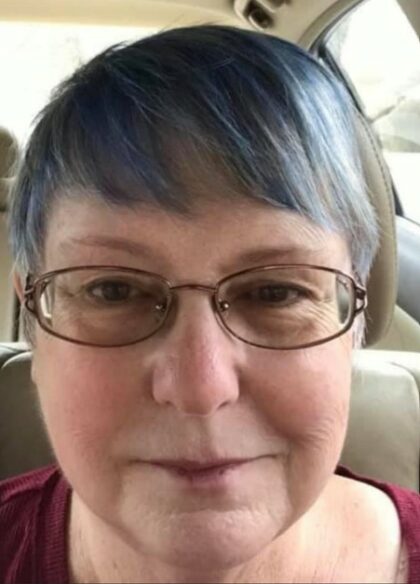 Jana Norris is a member of Red River UU Church. She earned her law degree from U of California Davis, practiced family law mostly in Dallas and Rockwall Counties, and retired to Grayson County, with a stint in MidCoast Maine.
 Mark’s Ph.D. is from Boston University in the area of Social Ethics, and he has served Boston University School of Theology (BUSTH) as a member of its Dean’s Advisory Board and as the alumnus representative on BUSTH’s Green Team as part of the Green Seminary Initiative.Mark has led and implemented a number of initiatives in coordination with the Division of Higher Education of the United Methodist Church including a Methodist Higher Education Global Ethics Initiative from 2008 to 2012, a United Methodist Higher Education Interfaith Initiative from 2015 to present, and a Global Methodist Higher Education Social and Ecological Responsibility Initiative from December 2016 to the present. Mark has published in the areas of Boston personalism, process philosophy and ethics, and ecological ethics.In 2017, the General Board of Church and Society of the United Methodist Church selected Dr. Davies to serve as the convener of the writing team tasked with revising “The Natural World” section of the Social Principles of the United Methodist Church. This is the first time the Social Principles have undergone a thorough revision since their adoption by the denomination in 1972.
 I’m a dad, minister, and science nerd in Dallas, TX.
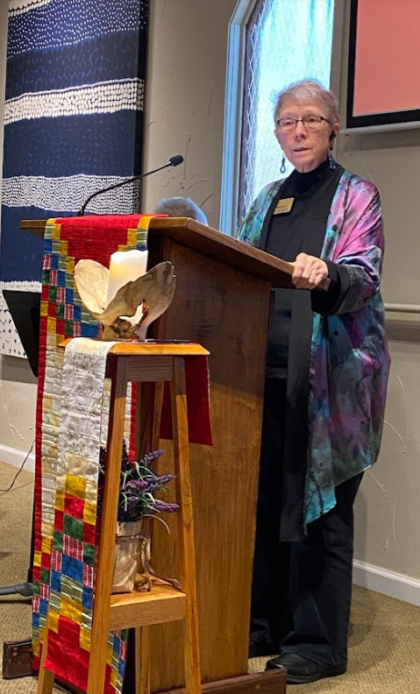 Marla Loturco is a lay leader of our congregation who first visited us in April 2008. Although she hadn’t set foot inside a church for forty years, she surprised herself by realizing this was a faith community that spoke to her heart. Marla has not taken her membership lightly as she has served on the bylaw revision committee, is the church (and the Texoma Earth Day Festival) webmaster, the church database guru, and our representative to North Texas UU Congregations (NTUUC). She joins in church social events and has been elected to the Committee on Ministry and President of the Board of Trustees. She is the recipient of NTUUC Marty Robinson Award for volunteerism as well as Red River Unitarian Universalists’ Bruce Cameron Distinguished Service Award. She currently is part of the AV team and a longtime member of the Worship Team where she creates meaningful and insightful worship experiences.